Drone Surveying Facts: How DJI is Revolutionizing Industries
Drone Surveying Facts — Filipino farmers are rapidly adopting DJI’s agricultural drones, marking a significant shift toward precision agriculture. These tools are helping boost yields, reduce costs and transform traditional farming practices.
Table of Contents
DJI Drones: Key Facts Driving Major Shifts Across Industries
DJI drones are reshaping field operations worldwide through improvements in RTK accuracy, AI obstacle avoidance, and advanced imaging—delivering measurable gains in efficiency, safety, and cost reduction.
The Technological Edge: RTK, AI Navigation, and Advanced Imaging
#1 Drone Surveying Facts: Precision Mapping and Surveying
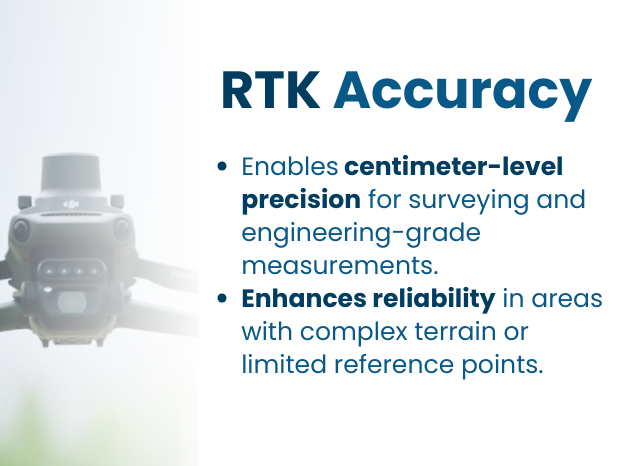
With RTK-enabled centimeter-level accuracy, they provide reliable geospatial information for urban development, resource planning, and infrastructure projects. Tasks that previously required weeks of fieldwork can now be completed in days.
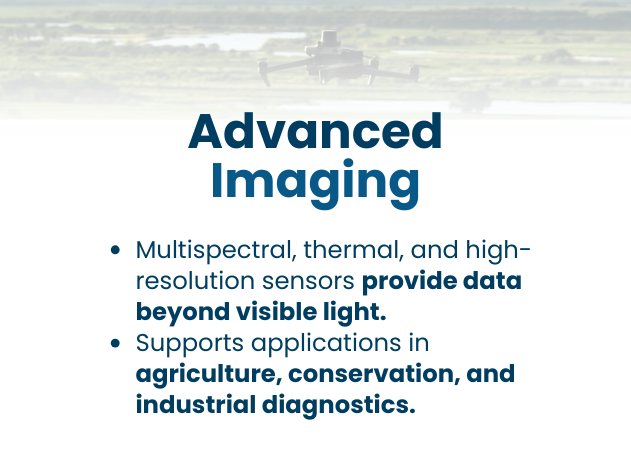
In agriculture, DJI drones increase efficiency through multispectral imaging, giving farmers precise insight into crop health, soil conditions, and pest issues.
The data supports targeted applications of water, fertilizer, and pesticides, enabling higher yields, reduced input waste, and more sustainable farm management.
#3 Drone Surveying Facts: Construction and Infrastructure Monitoring
Construction teams rely on DJI drones for real-time site monitoring, hazard detection, and 3D modeling.
Aerial inspections reduce the need for manual checks in high-risk zones, provide accurate progress tracking, and streamline resource allocation. This improves both safety and project delivery timelines.
#4 Drone Surveying Facts: Public Safety and Industrial Inspections
Public safety agencies deploy DJI drones for rapid damage assessments, search and rescue, and firefighting operations. Thermal sensors and live aerial intelligence help responders locate survivors and evaluate hazardous areas quickly.
Industrial sectors use drones to inspect inaccessible assets—such as power lines, towers, and pipelines—minimizing downtime and reducing operator risk.
Environmental groups use DJI drones to track wildlife populations, survey forests, and monitor environmental degradation. Aerial data enables accurate reporting on deforestation, habitat changes, and illegal activities.
Drones provide a non-intrusive method to observe ecosystems and support long-term conservation strategies.
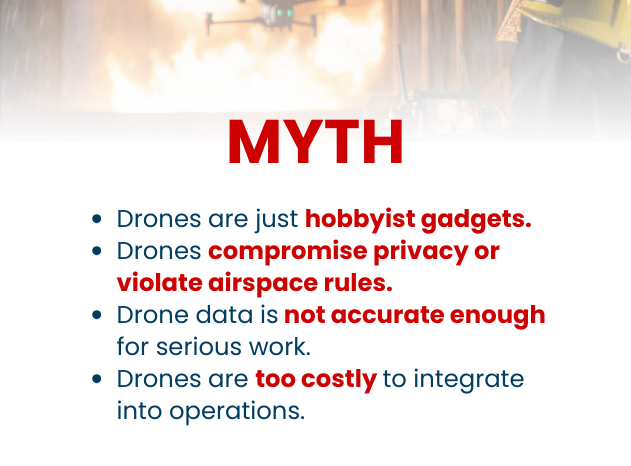
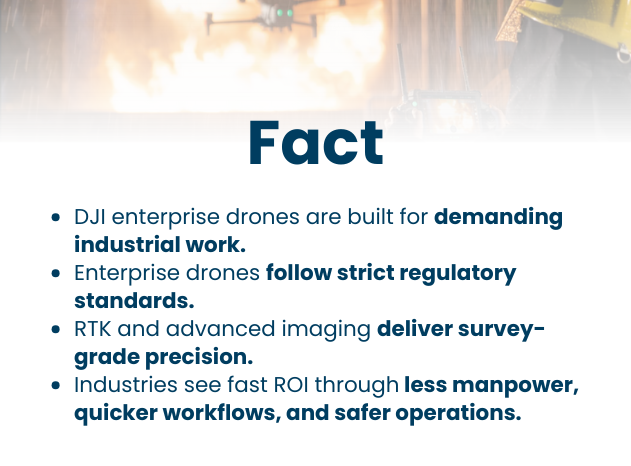
Myth vs. Fact: Clarifying Drone Misconceptions
Need more Drones?
Unlock precision, speed, and safety for your operations—experience the power of DJI enterprise drones today. Contact drone@gennexcorp.com